09/05/2025

Heavy vehicle safety has always relied on strong people, strong processes, and well-maintained vehicles.

Those foundations still matter. Drivers need the right training. Vehicles need to be maintained properly. Fleets need clear procedures, regular checks, and a safety culture that is understood across the business.

But modern fleet safety is also moving into a new stage.

As vehicles operate in busier environments, and as safety expectations continue to rise, many organisations are looking at what the next layer of protection should look like. Increasingly, that layer is technology – not as a replacement for drivers, but as a way to support them in real operating conditions.

That is where modern heavy vehicle safety systems are changing the conversation.

From Individual Controls to Connected Safety

Fleet safety is often talked about in separate parts.

Blind spots. Reversing. Rollaways. Driver awareness. Site procedures. Vehicle maintenance.

In practice, these issues are connected. They all sit around the same question: how well is risk being managed around the vehicle?

A driver may be turning through a busy area. Reversing into a tight space. Stopping and starting throughout the day. Working around pedestrians, site crews, customers, or other road users. In these situations, safety depends on more than one action or one point of visibility.

This is why safety-mature fleets are increasingly looking beyond single controls. The focus is shifting toward systems that work together – helping drivers see more, respond earlier, and reduce the chance that a missed hazard becomes an incident.

This approach fits with New Zealand’s wider Safe System thinking, which recognises that safe outcomes are not created by driver behaviour alone. People, vehicles, roads, workplaces, procedures, and technology all have a role to play. (1)

Where MAX-SAFE Fits

The MAX-SAFE Safety EcoSystem™ is built around this more connected approach to heavy vehicle safety.

Rather than positioning safety technology as a one-off add-on, MAX-SAFE brings together a suite of systems designed to help protect people, vehicles, equipment, and property around heavy vehicles.

The ecosystem uses onboard intelligence and technologies such as radars, sensors, AI cameras, software, and screen integration to help improve awareness and support safer vehicle operation.

The aim is not to make safety more complicated. It is to make it more complete.

For fleets, this matters because different risks can appear at different points around the vehicle. A side blind spot creates one type of risk. A reversing movement creates another. Unintended vehicle movement brings its own set of risks.

MAX-SAFE is designed to help fleets build protection around those risk points over time.

Safety Around the Side of the Vehicle

Side blind spots remain one of the most difficult areas for heavy vehicle drivers to manage, particularly during turning or pulling across to the left or right in areas where pedestrians, cyclists, or workers may be nearby.

MAX-SAFE Side View™ is designed to support drivers by monitoring configurable zones beside the vehicle. Using camera-based technology and AI detection, it can identify vulnerable road users within the monitored area and provide visual and audible alerts.

This helps strengthen side awareness in situations where mirrors and direct vision may still leave gaps.

As part of the wider MAX-SAFE Safety EcoSystem™, Side View shows how technology can support driver decision-making around one of the most important risk areas of a heavy vehicle: the space beside it.

Safety When the Vehicle Should Stay Still

Not every heavy vehicle risk happens while the vehicle is being driven.

Unintended movement can create serious risk when a vehicle is expected to remain stationary. This is especially important in operating environments where drivers may be moving in and out of the cab, working around other people, or stopping frequently throughout the day.

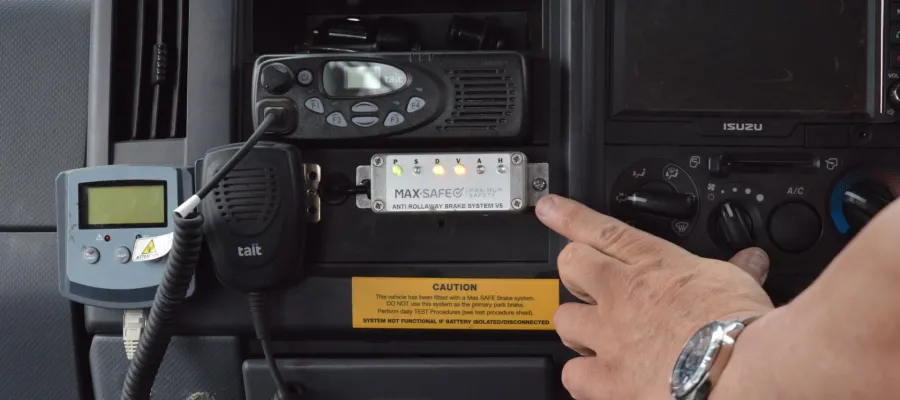
The MAX-SAFE Anti-Rollaway Brake System™ is designed to provide an additional layer of protection by monitoring key vehicle inputs and responding when rollaway or idle creep risk is detected.

Through visual and audible warnings, and braking intervention in certain situations, the system helps reduce reliance on manual checks alone and supports safer vehicle operation when the vehicle should not be moving.

Safety Behind the Vehicle

Reversing is another area where visibility and timing matter. 

WorkSafe guidance around reversing vehicles and mobile plant highlights the importance of managing reversing risks through practical controls, especially where vehicles operate around people. (2) 

MAX-SAFE Reverse Watch® is designed to support drivers by monitoring a programmed danger zone behind the vehicle when reverse is selected. Using a rear-mounted radar, the system can detect obstacles within the monitored area and provide dashboard and audible alerts. 

Reverse Watch works with the MAX-SAFE Anti-Rollaway Brake System™ to help stop the vehicle by applying the brakes when the system is triggered. 

As part of the wider MAX-SAFE Safety EcoSystem™, Reverse Watch adds active monitoring to one of the most common close-proximity movements in heavy vehicle operation.

Building a System Over Time

One of the strengths of the MAX-SAFE Safety EcoSystem™ is that it can be built progressively. 

Not every fleet has the same starting point. For some operators, the priority may be side visibility. For others, it may be reversing safety or rollaway prevention. The right solution depends on where the greatest risks sit within the fleet’s day-to-day operation. 

This makes the ecosystem approach practical. Fleets can start with the area of greatest need, then add further layers of protection as their safety priorities, vehicle requirements, and operating environments evolve. 

Over time, this helps create a more complete safety system around the vehicle – one that supports drivers, strengthens fleet safety culture, and gives decision-makers greater confidence that risk is being managed proactively.

The Bottom Line

Modern heavy vehicle safety is not about replacing good drivers or ignoring the importance of training and procedures.

It is about recognising that strong safety outcomes come from multiple layers working together.

For New Zealand fleets, modern safety technology offers a smarter way to support drivers, protect people around vehicles, reduce the risk of equipment and property damage, and build stronger safety systems across the business.

MAX-SAFE brings that thinking together through a connected safety ecosystem – helping fleets move beyond individual products and toward a more complete approach to heavy vehicle safety technology.

To learn more about MAX-SAFE safety solutions for your fleet, contact Autokraft Electrical & Diesel.


📞 Phone: 06 359 0100
✉️ Email: [email protected]
📍 Address: 691 Tremaine Ave Palmerston North

Footnotes

(1) Ministry of Transport, Road to Zero: New Zealand’s Road Safety Strategy 2020–2030, outlining the Safe System approach and shared responsibility for road safety.

(2) WorkSafe New Zealand, Safe reversing and spotting practices, providing guidance for managing risks around reversing vehicles and mobile plant.

(3) Ministry of Transport, Safety – Annual statistics: Trucks, reporting New Zealand crash data involving trucks.

Back To Top

Popular Articles

20 – 02 – 2025